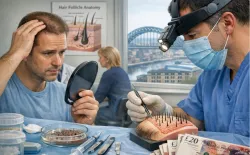
Hair loss carries a quiet psychological weight. For some men and women it emerges slowly in their twenties, while others notice it after illness, stress, or hormonal change. The search for solutions often leads to the same question: how much does a hair transplant cost and what exactly are you paying for?
In Newcastle and the wider north east, the price of hair restoration surgery reflects a mixture of medical expertise, surgical time, and the scale of hair loss being treated. It is a private procedure in the UK and therefore sits outside NHS funding. Patients pay directly for treatment, which can lead to large variations in quoted prices.
Understanding the typical range helps patients approach consultations with realistic expectations.
Across Newcastle clinics, most hair transplant prices fall within a fairly consistent range. Smaller procedures designed to restore a receding hairline may start around £3000. Larger cases involving several thousand grafts often sit between £4000 and £7000.
These figures align with broader UK pricing. Nationally, the average cost of a hair transplant sits around £4820, though prices can extend well beyond this depending on graft numbers and surgical expertise.
The wide spread in pricing reflects several clinical realities. Hair transplantation is not a standardised procedure performed in the same way for every patient. Surgeons must first assess the pattern of hair loss, the density of the donor area at the back of the scalp, and the size of the region requiring coverage.
One patient might require only 1200 grafts to rebuild the front hairline. Another with advanced male pattern baldness could require 3000 grafts or more. The difference in surgical time alone may extend from four hours to an entire day in theatre.
This is why the consultation stage matters. A surgeon evaluates not just the cosmetic goal but the biological limitations of the patient’s hair supply.
The price quoted at consultation reflects several medical and logistical factors rather than a simple cosmetic fee.
The most important variable is the number of grafts required. Each graft contains between one and four hairs, and thousands may be transplanted during a single procedure. Larger areas of baldness therefore require longer surgery and more clinical staff.
Surgeon experience also plays a role. Hair transplantation demands fine motor precision under magnification. The surgeon must create recipient sites that mimic the angle, direction, and density of natural hair growth. Even small technical errors can produce unnatural results that remain visible for life.
Clinic regulation and surgical standards contribute to pricing as well. In the UK, clinics performing hair restoration surgery must operate within strict clinical governance and infection control frameworks. The procedure takes place under local anaesthetic and requires trained medical staff throughout the process.
For this reason, very low prices should prompt careful scrutiny. High volume surgery performed with minimal doctor involvement has been widely criticised in medical literature. It is also worth checking the major review sites for previous experiences of other patients like this one: My Hair UK reviews
Hair transplantation works because follicles taken from the back and sides of the scalp retain their genetic resistance to dihydrotestosterone, the hormone that drives male pattern baldness. When transplanted to thinning areas, these follicles continue to grow hair for many years.
Clinical research has demonstrated good survival rates for transplanted follicles when the procedure is performed correctly. A systematic review reported graft survival around 82.7 percent at one year following transplantation.
Long term studies also show that transplanted hair can remain present for several years, although density may gradually decline over time in some individuals.
For patients considering surgery, this evidence highlights an important point. A hair transplant is not simply a cosmetic procedure performed in isolation. It forms part of a long term management strategy for androgenetic alopecia.
Newcastle serves a large population across Northumberland, Durham, and the wider north east. The city’s strong medical infrastructure and university hospitals have helped support the growth of private surgical services, including hair restoration.
For many patients, the main advantage of choosing a local clinic is follow up care. Hair transplant recovery occurs over months rather than days. Patients may need to attend reviews to monitor growth, assess the donor area, and discuss future treatment plans if hair loss progresses.
Travelling abroad for cheaper surgery may appear attractive initially. Yet distance can complicate aftercare should swelling, infection, or uneven growth occur.
This is why many UK surgeons advise patients to prioritise clinical oversight rather than price alone.
Hair loss sometimes reflects underlying health issues. Thyroid disease, iron deficiency, autoimmune disorders, and certain medications can all contribute to thinning hair.
For this reason it is sensible to arrange a routine health check with your GP before booking a surgical consultation. Blood tests can identify reversible causes of hair loss and provide reassurance that you are medically fit for a procedure performed under local anaesthetic.
If you live in Newcastle city centre, several NHS GP surgeries provide accessible primary care.
• Jesmond Health Partnership
• Saville Medical Group
A brief appointment with your GP allows discussion of hair loss history, medication review, and general health assessment. This information can then be shared with the hair transplant surgeon during consultation.
Patients often spend years considering hair restoration surgery before taking the next step. The financial cost matters, but so does the long term outcome.
A well planned hair transplant performed by an experienced surgeon can restore a natural hairline and improve confidence for many years. Yet the procedure demands careful assessment, honest expectations, and thoughtful decision making.
Price alone rarely tells the full story. The true value lies in the balance between surgical skill, realistic planning, and the patient’s own biology.
Similar Articles:
jobs.nationalguard.com/company/3056/combining-hair-transplants-with-other-treatments/
jobs.nationalguard.com/company/3644/protecting-your-hair-transplant/
jobs.nationalguard.com/company/3496/comparing-uk-and-turkish-hair-transplant-clinics/
jobs.nationalguard.com/company/3186/my-hair-beard-clinic/
jobs.nationalguard.com/company/3301/buzz-cut-hair-transplant/