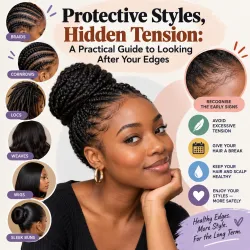
Braids, cornrows, locs, weaves, wigs and sleek buns are part of everyday life for millions of people. They can save time, protect fragile hair from daily handling, and express identity, culture and personal style. Many are described as "protective styles" for good reason.
There is, however, a catch that is not always discussed in the salon chair. When a style pulls too tightly on the hair, or is worn in the same way for too long, it can gradually damage the follicles along the hairline. Over time, that tension can lead to a form of hair loss called traction alopecia.
This article is not about giving up the styles you love. It is about understanding where the risk comes from, recognising the early warning signs, and making small changes that allow you to keep wearing your preferred styles while protecting your hair for the long term.
Traction alopecia is hair loss caused by repeated or prolonged pulling on the hair. The British Association of Dermatologists describes it as hair loss resulting from tension on the hair follicles, most often from tight hairstyles, and notes that early traction alopecia can be reversed if the pulling stops.
The key point is time. In the early stages, the follicles are stressed but still alive, and hair can grow back once the tension is removed. If pulling continues over months or years, the follicles can become scarred, at which point the hair loss may become permanent. DermNet explains this progression from a reversible early stage to a later, scarring stage.
That is why catching it early matters so much.
Anyone who regularly wears tight styles can develop traction alopecia. According to the American Academy of Dermatology, it is particularly common among girls and women of African descent, largely because tightly pulled styles are widely worn, and because the shape of the hair follicles in tightly curled hair makes it more vulnerable to damage from tension. The same page notes that ballet dancers, military personnel and anyone required to wear their hair pulled back for work are also at higher risk.
The risk comes from the styling practice rather than from hair type or background alone. A loose, well-installed style worn for a sensible length of time carries far less risk than the same style installed tightly and left in for months.
The American Academy of Dermatology lists the following styles as capable of causing traction alopecia when they are worn too tightly:
It also points out that the constant rubbing of a hat, headscarf or other covering can contribute, particularly if the hair is pulled back tightly underneath. Choosing a silk or satin covering and pulling the hair back loosely are simple ways to reduce friction.
Traction alopecia usually starts subtly, and the earliest signs are often felt before they are seen. The American Academy of Dermatology recommends loosening or removing a style straight away if you notice:
Other signs to look out for over time include:
One helpful habit is a monthly check. Look closely at your hairline, temples and the areas above your ears in good light, and consider taking photos to compare over time. Gradual changes are much easier to spot side by side.
The good news is that most of the steps that protect your hair are simple and do not require giving up any particular style.
The American Academy of Dermatology's advice on preventing hair damage from weaves and extensions includes further practical tips for anyone who wears these styles regularly.
If you notice early warning signs, the first and most important step is to reduce the tension. That might mean loosening a style, taking it out early, or switching to looser styles for a while.
If the thinning does not improve, if your scalp is sore, itchy or inflamed, or if you are unsure what is causing the hair loss, it is worth speaking to your GP. They may refer you to a dermatologist, who can examine your scalp closely and, if needed, take a small sample of skin to confirm whether the follicles are still active or have become scarred. This distinction matters, because it determines whether regrowth is likely.
It is also worth knowing that not all hair loss along the hairline or on top of the scalp is traction alopecia. Other conditions, including central centrifugal cicatricial alopecia (CCCA), which starts at the crown and is more common in women of African descent, can look similar at first. A specialist can tell them apart and advise on the right approach. The American Academy of Dermatology's page on hair loss in Black women is a useful overview of the different causes.
In the early stages, often yes. Once the tension is removed, hair can regrow over the following months, although because hair grows slowly, it may take some time before the difference is noticeable. Treatment at this stage focuses mainly on removing the cause and settling any inflammation.
In long-standing cases where the follicles have scarred, the hair is unlikely to return on its own. At that stage, options generally focus on camouflage, such as wigs, styling or scalp products, and in some cases, surgical hair restoration can be discussed with a specialist once the cause of the hair loss has been fully addressed and the condition is stable.
Protective styles can genuinely protect the hair, but only when they are installed without excess tension and given regular breaks. Paying attention to pain, checking your hairline regularly, and speaking up when a style feels too tight are simple habits that make a real difference. Traction alopecia is one of the few types of hair loss that is largely preventable, and when it is caught early, it is often reversible.
For more on the causes, stages and treatment of this condition, including how it differs from other types of hair loss, see this guide to traction alopecia, published by My Hair UK.
Related Articles:
jobs.nationalguard.com/company/3056/combining-hair-transplants-with-other-treatments/
jobs.nationalguard.com/company/3186/my-hair-beard-clinic/
jobs.nationalguard.com/company/3301/buzz-cut-hair-transplant/
jobs.nationalguard.com/company/3496/comparing-uk-and-turkish-hair-transplant-clinics/
jobs.nationalguard.com/company/3644/protecting-your-hair-transplant/